

Pipe Repair Couplers, Flush Valves & PVC Solvent Cement for Irrigation Pipeline Maintenance
An irrigation system that was running like clockwork six months ago is not going to break down suddenly. It fails gradually. A joint starts leaking slightly enough to lower pressure at the end of the lateral. Sediment builds up in the drip tubing until the emitters no longer operate properly. A small crack in a pipe from ground movement is overlooked because the leak is minimal and it will mean digging to fix it. And then the season starts and the irrigation system underperforms and nobody can quite figure out why.
Most irrigation problems stem from maintenance problems, not a catastrophic failure. Small issues that were ignored for long enough to become a big problem. And there is nothing complicated about the solutions to this problem, but they must be appropriate for the irrigation system.
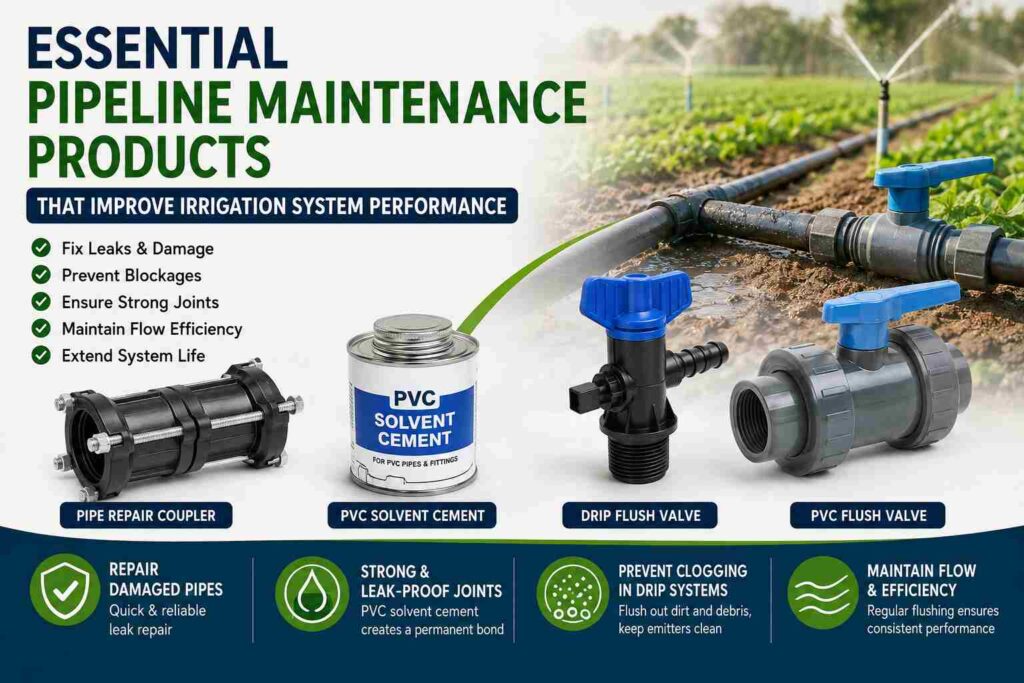
Pipe Repair Couplers: Fixing Without Replacing
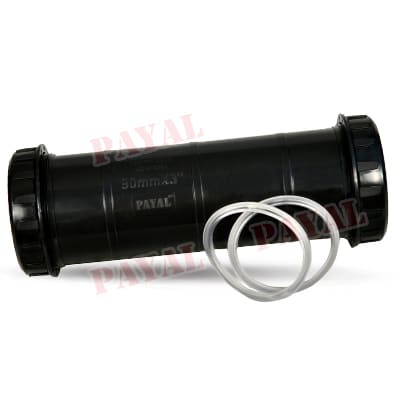
Damage can occur to underground piping systems. Soil movement, vehicular traffic above shallowly buried pipes, freezing and thawing, installation damage that was undetected at the time of installation. When such damage occurs, the decision must be made to either excavate or replace part of the pipe or to repair the damage.
This is where the Pipe Repair Coupler becomes a valuable tool. It spans the damaged portion of the pipe and provides a coupling joint between the undamaged portions of the pipe on either end. This repair will save time compared to excavation and replacement, causes less disruption to the surrounding area and brings the pipeline back into service.
The specification needs to suit the pipe. The outside diameter, the wall thickness and the material of construction. A coupler that does not fit tightly or is rated below the pressure rating of the system is not a repair; it is a guaranteed future failure.
PVC Solvent Cement: What Actually Creates the Bond
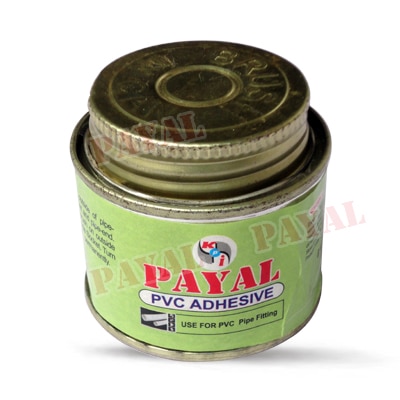
People who have not worked with PVC solvent cement sometimes think of it as glue. It is not. It is a chemical fusion process. The cement contains solvents that partially dissolve the PVC surface of both the pipe and the fitting. When they are pushed together, the softened surfaces merge. When the solvent flashes off, what is left is not two pieces joined by an adhesive layer. It is effectively one piece of PVC.
That is why PVC Solvent Cement joints, done correctly, are stronger than the pipe itself. And why joints done incorrectly fail in ways that are difficult to diagnose. Surfaces that were not cleaned before cementing. Cement applied to wet pipe. Joints assembled after the cement started to skin over. Any of these produce a bond that looks fine on the outside and has voids or weak spots inside.
Clean, dry surfaces. Correct primer where the pipe and fitting type require it. Cement applied to both surfaces. Joint assembled and held for the time the product specifies. These steps are not suggestions. They are what determines whether the joint holds.
Why Drip Systems Need Flushing More Than Anyone Thinks
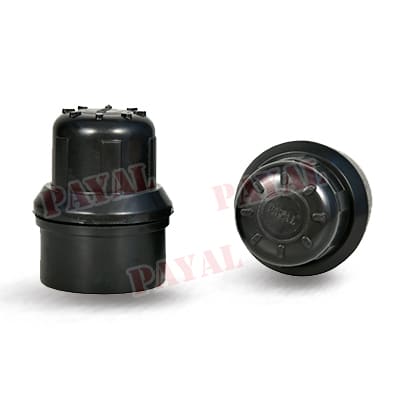
Drip irrigation is efficient precisely because it delivers water in small, controlled volumes through small emitters. That precision is also the vulnerability. The same passages that deliver water accurately can be blocked by particles that would flow straight through a sprinkler or flood irrigation system without any effect.
Sediment, organic material, mineral deposits from hard water, biofilm. These accumulate in drip lines over a season and the effect is gradual enough that it is not always obvious until emitter output is measured and compared across the system. By then the unevenness in crop growth or soil moisture is already telling the story.
A Drip Flush Valve at the end of each lateral gives debris somewhere to go. When the system is opened for flushing, accumulated material travels to the flush point and exits rather than sitting in the line or reaching the emitters. Regular flushing, done systematically at the end of each irrigation cycle or on a schedule that suits the water quality and system design, is what keeps drip systems delivering what they are supposed to deliver.
PVC Flush Valves in Broader Distribution Systems
The same principle applies to larger PVC-based distribution systems. Pipelines that carry water from source to field or through distribution networks accumulate sediment over time, particularly in lower-velocity sections where particles have opportunity to settle.
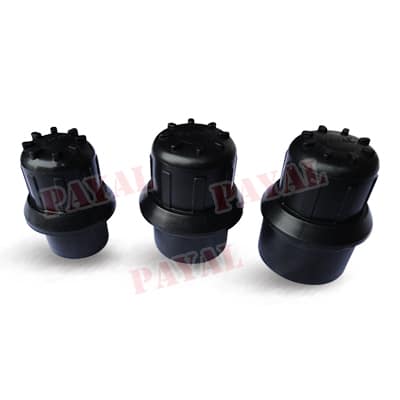
A PVC Flush Valve at appropriate points in the system provides controlled discharge for accumulated material. The valve is opened periodically, the system is flushed, the valve is closed. It is not a complex process but it requires the right component in the right location, and it requires doing it on a schedule rather than waiting until flow restriction becomes obvious.
Selecting the Right Products for the System
Compatibility is the starting point for every maintenance product decision. The repair coupler has to suit the pipe material and outside diameter. The solvent cement has to be formulated for the PVC type in the system. Flush valves have to be rated for the operating pressure and sized for the flow rate required during flushing to be effective.
Beyond compatibility, quality of manufacture determines how these products perform over time. A coupler with inconsistent wall thickness. Solvent cement with degraded chemical composition from poor storage or age. A flush valve with a seal that begins to weep after the first season. These are not hypothetical problems.
FAQs
Bridges a damaged pipe section and creates a secure connection between intact pipe ends, allowing repair without full section replacement. Must be matched to pipe dimensions, material, and pressure rating.
It chemically fuses pipe and fitting surfaces rather than bonding them with adhesive. Correct surface preparation and assembly procedure are essential for a joint that performs as intended.
Drip emitters are sensitive to particle blockage. A flush valve provides a controlled exit point for accumulated sediment and debris during regular flushing, maintaining emitter performance.
Provides periodic discharge of accumulated sediment from distribution pipelines, maintaining flow consistency and reducing blockage-related pressure loss.
Depends on water quality, system design, and emitter sensitivity. Drip systems generally benefit from flushing at the end of each irrigation event or on a regular schedule. Larger distribution systems typically flush seasonally or when flow changes are detected.